

All Classes Namespaces Files Functions Variables Typedefs Enumerations Enumerator Properties Friends Defines

Brief description of class still missing. More...
#include <HRFK.h>
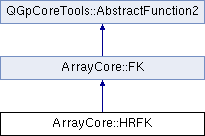
Public Member Functions | |
| Complex * | crossCorrelationMatrix (int component) |
| Complex * | crossCorrelationMatrix (double angle) |
| HRFK (QList< FKStationSignals * > array) | |
| void | initOperator (Complex *covmat, double dampingFactor, QString *log=0) |
| virtual double | value (double x, double y) const |
| virtual double | value (double x, double y, int index) const |
| ~HRFK () | |
Brief description of class still missing.
Full description of class still missing
| ArrayCore::HRFK::HRFK | ( | QList< FKStationSignals * > | array | ) |
Description of constructor still missing
References ArrayCore::FK::_array, ArrayCore::FKStationSignals::isSelected(), and TRACE.
    : FK(array)
{
  TRACE;
  _selectedStationCount=0;
  _stationIndexes=new int[_array.count()];
  int n=_array.count();
  for(int i=0; i<n; i++ ) {
    FKStationSignals * s=static_cast<FKStationSignals *>(_array.at(i));
    if(s->isSelected()) {
      _stationIndexes[_selectedStationCount]=i;
      _selectedStationCount++;
    }
  }
  // Allocation of cross corelation matrix called R
  _Rmatrix=new Complex[ _selectedStationCount * _selectedStationCount ];

  // Proper identification of horizontal components if any
  switch (array.first()->nComponents()) {
  case 2:
    _northIndex=0;
    _eastIndex=1;
    break;
  case 3:
    _northIndex=1;
    _eastIndex=2;
    break;
  default:
    _northIndex=0;
    _eastIndex=0;
    break;
  }
}
| Complex * ArrayCore::HRFK::crossCorrelationMatrix | ( | int | component | ) |
References ArrayCore::FK::_array, ArrayCore::FK::_gaussianPtr, ArrayCore::FK::_iFreqMax, ArrayCore::FK::_iFreqMin, QGpCoreTools::conjugate(), and ArrayCore::FKStationSignals::getSignalSpectrum().
Referenced by HRFKLoopTask::initGridValues(), and HRFKTimeWindows::setComponent().
{
  Complex * covmat=new Complex[ _selectedStationCount * _selectedStationCount ];
  // Cache for signals
  Complex * sig=new Complex[ _selectedStationCount ];
  /*
     Filling in the upper part of the matrix and the diagonal elements with the cross products
     Summation over all frequency samples
  */
  Complex tmp, specRow, specCol;
  QList<FKStationSignals *>::iterator itrow, itcol;
  for(register int iFreq=_iFreqMin;iFreq <= _iFreqMax;iFreq++ ) {
    // Fill in the cache with signals
    for(register int s=0;s < _selectedStationCount;s++ ) {
      FKStationSignals * stat=_array.at(_stationIndexes[s] );
      sig[s]=stat->getSignalSpectrum(component, iFreq);
    }
    for(register int row=0;row < _selectedStationCount;row++ ) {
      for(register int col=row;col < _selectedStationCount;col++ ) {
        tmp=sig[col];
        tmp=conjugate(tmp);
        tmp *= sig[row];
        tmp *= _gaussianPtr[iFreq];
        covmat[ col * _selectedStationCount + row ] += tmp;
      }
    }
  }
  delete [] sig;
  return covmat;
}
| Complex * ArrayCore::HRFK::crossCorrelationMatrix | ( | double | angle | ) |
angle is counted from North clockwize
References ArrayCore::FK::_array, ArrayCore::FK::_gaussianPtr, ArrayCore::FK::_iFreqMax, ArrayCore::FK::_iFreqMin, QGpCoreTools::conjugate(), QGpCoreTools::Angle::cos(), ArrayCore::FKStationSignals::getSignalSpectrum(), QGpCoreTools::Angle::setDegreeAzimuth(), and QGpCoreTools::Angle::sin().
{
  Angle a;
  a.setDegreeAzimuth(angle);
  Complex * covmat=new Complex[ _selectedStationCount * _selectedStationCount ];
  // Cache for rotated signals
  Complex * sig=new Complex[ _selectedStationCount ];
  /*
     Filling in the upper part of the matrix and the diagonal elements with the cross products
     Summation over all frequency samples
  */
  Complex tmp, specRow, specCol;
  QList<FKStationSignals *>::iterator itrow, itcol;
  for(register int iFreq=_iFreqMin;iFreq <= _iFreqMax;iFreq++ ) {
    // Fill in the cache with rotated signals
    for(register int s=0;s < _selectedStationCount;s++ ) {
      FKStationSignals * stat=_array.at(_stationIndexes[s] );
      Complex& c=sig[s];
      c=stat->getSignalSpectrum(_eastIndex, iFreq);
      c *= a.cos();
      tmp=stat->getSignalSpectrum(_northIndex, iFreq);
      tmp *= a.sin();
      c += tmp;
    }

    for(register int row=0;row < _selectedStationCount;row++ ) {
      for(register int col=row;col < _selectedStationCount;col++ ) {
        tmp=sig[col];
        tmp=conjugate(tmp);
        tmp *= sig[row];
        tmp *= _gaussianPtr[iFreq];
        covmat[ col * _selectedStationCount + row ] += tmp;
      }
    }
  }
  delete [] sig;
  return covmat;
}
| void ArrayCore::HRFK::initOperator | ( | Complex * | covmat, |
| double | dampingFactor, | ||
| QString * | log = 0 |
||
| ) |
References ArrayCore::FK::_frequency, ArrayCore::FK::_iFreqMax, ArrayCore::FK::_iFreqMin, QGpCoreTools::conjugate(), QGpCoreTools::Complex::re, QGpCoreTools::sqrt(), QGpCoreTools::tr(), and ArrayCore::zgesvd_().
Referenced by HRFKLoopTask::initGridValues(), and HRFKTimeWindows::setComponent().
{
  /*
   LAPACK is assuming matrix stored in vectors column by column

     For a MxN matrix:
        a(1,1) ... a(m,1) a(1,2) ... a(m,2)    ...   a(1,n) ... a(m,n)

   On output for _Rmatrix it is the contrary:

     For a MxN matrix:
        a(1,1) ... a(1,n) a(2,1) ... a(2,n)    ...   a(m,1) ... a(m,n)
  */
  int nostat2=_selectedStationCount * _selectedStationCount;

  //printf("Upper\n");
  //printMatrix(covmat, _selectedStationCount, _selectedStationCount);

  /*
     Computes the auto-power for normalizing, normalizing factor also include the division by the number
     of frequency samples
  */
  double * scale=new double[ _selectedStationCount ];
  for(register int row=0;row < _selectedStationCount;row++ ) {
    double s=covmat[ row * _selectedStationCount + row ].re();
    if(s==0) { // Flat spectrum for one station
      return initOperatorError( "Flat spectrum, check signal", log);
    }
    scale[ row ]=1.0/sqrt(s);
  }
  /*
     Filling in the lower part of the matrix with conjugates of the upper part and normalizing
  */
  for(register int row=0;row < _selectedStationCount;row++ ) {
    for(register int col=row;col < _selectedStationCount;col++ ) {
      Complex& upper=covmat[ col * _selectedStationCount + row ];
      Complex& lower=covmat[ row * _selectedStationCount + col ];
      upper *= scale[ row ] * scale[ col ];
      lower=conjugate(upper);
    }
  }
  delete [] scale;
  //printf("Full:\n");
  //printMatrix(covmat, _selectedStationCount, _selectedStationCount);
  // Damping
  if(dampingFactor>0) {
    dampingFactor=1.0-dampingFactor;
    for(register int row=0;row < _selectedStationCount;row++ ) {
      for(register int col=row;col < _selectedStationCount;col++ ) {
        covmat[ row * _selectedStationCount + col ] *= dampingFactor;
      }
    }
    /*
      Add white noise to avoid singular matrix
    */
    dampingFactor=1.0-dampingFactor;
    for(register int el=0; el < _selectedStationCount;el++ ) {
      covmat[ el + _selectedStationCount * el ] += dampingFactor;
    }
  }
  //printf("With noise:\n");
  //printMatrix(covmat, _selectedStationCount, _selectedStationCount);
  /*
     need to allocate the matrices, etc.
     I'll use now code from CLAPACK!
    matrices are allocated in 1 dim.-array!
  */
  Complex *a;   /* copy of covmat */
  Complex *vt;   /* nullspace vectors */
  Complex *u;   /* eigenvectors */
  double *s;   /* eigenvalues */
  Complex *work;    /* work space */
  double *rwork;   /* another workspace */
  char jobu, jobvt;    /* flags what to do in zgesvd_ */
  int lda, ldu, ldvt;   /* dimensions of SVD problem */
  int lwork, info;    /* dimension of workspaces */
  int mm, nn;

  a=new Complex[ nostat2 ];
  u=new Complex[ nostat2 ];
  vt=new Complex[ nostat2 ];
  work=new Complex[ 50 * _selectedStationCount + 1 ];
  rwork=new double[ 5 * _selectedStationCount ];
  s=new double [ _selectedStationCount ];

  /*
     Copy covmat to a
  */
  for(register int i=nostat2 - 1;i >= 0;i-- ) {
    a[ i ]=covmat[ i ];
  }
  //printf("a\n");
  //printMatrix(a, _selectedStationCount, _selectedStationCount);
  /*********************************************/
  /* now find the eigenvalues and eigenvectors */
  /* driver ZGESVD already sorts the basis!    */
  /*********************************************/
  // CLAPACK is probalby not thread safe... lock it
  jobu='A';
  jobvt='A';
  lda=ldu=ldvt=mm=nn=_selectedStationCount;
  lwork=50 * _selectedStationCount + 1;
  static QMutex mutex;
  mutex.lock();
  zgesvd_(&jobu, &jobvt, &mm, &nn, a, &lda, s, u, &ldu, vt, &ldvt, work, &lwork, rwork, &info);
  mutex.unlock();

  /* Output is U, SIGMA and VT

        A=U * SIGMA * VT

     VT being the conjugate-transpose matrix of V

        A^-1=V * SIGMA^-1 * UT

     UT being the conjugate-transpose matrix of U
  */
  //printf("u\n");
  //printMatrix(u, _selectedStationCount, _selectedStationCount);
  //printf("s\n");
  //printMatrix(s, 1, _selectedStationCount
  //printf("vt\n");
  //printMatrix(vt, _selectedStationCount, _selectedStationCount);*/

  // Check if matrix has a true inverse (good rank)
  delete [] work;
  delete [] rwork;
  delete [] covmat;
  delete [] a;
  double sRef=1e-12 * s[ 0 ];
  for(register int row=0;row < _selectedStationCount;row++ ) {
    if(s[ row ] < sRef) {
      static const char * msg=QT_TR_NOOP( "At %1 Hz, effective rank %2 (%3 frequency samples), "
                                            "singular cross spectral matrix. The effective "
                                            "rank should be at least equal to the number of stations (%4). Either "
                                            "increase the time window lenght or the frequency band width. "
                                            "An empy fk map will be produced." );
      delete [] vt;
      delete [] u;
      delete [] s;
      return initOperatorError(tr( msg).arg(_frequency)
                                         .arg(row)
                                         .arg(_iFreqMax-_iFreqMin+1)
                                         .arg(_selectedStationCount), log);
    }
  }
  // allocate a new temporatry matrix for multiplication of S and U
  Complex * invSUT=new Complex[ nostat2 ];
  for(register int row=0;row < _selectedStationCount;row++ ) {
    double si=1./s[ row ];
    for(register int col=0;col < _selectedStationCount;col++ ) {
      Complex& invSUTElement=invSUT[ col * _selectedStationCount + row ];
      Complex& uElement=u[ row * _selectedStationCount + col ];
      invSUTElement=uElement;
      invSUTElement=conjugate(invSUTElement);
      invSUTElement *= si;
    }
  }
  delete [] u;
  delete [] s;
  //printf("invSUT\n");
  //printMatrix(invSUT, _selectedStationCount, _selectedStationCount);
  // proceed with V * invSUT
  for(register int row=0;row < _selectedStationCount;row++ ) {
    for(register int col=0;col < _selectedStationCount;col++ ) {
      Complex& RElement=_Rmatrix[ row * _selectedStationCount + col ];
      RElement=0;
      for(register int k=0;k < _selectedStationCount;k++ ) {
        Complex& vtElement=vt[ row * _selectedStationCount + k ];
        Complex tmp=vtElement;
        tmp=conjugate(tmp);
        tmp *= invSUT[ col * _selectedStationCount + k ];
        RElement += tmp;
      }
    }
  }
  delete [] invSUT;
  delete [] vt;
  //printf("R\n");
  //printMatrix(_Rmatrix, _selectedStationCount, _selectedStationCount);

  // Check matrix inversion
  /*for(register int row=0;row < _selectedStationCount;row++ ) {
    for(register int col=0;col < _selectedStationCount;col++ ) {
      Complex sum;
      for(int k=0;k<_selectedStationCount;k++) {
        Complex tmp=covmat[row * _selectedStationCount + k];
        tmp*=_Rmatrix[col * _selectedStationCount + k];
        sum += tmp;
      }
      printf("%12lg+i*%12lg  ",sum.re(), sum.im());
    }
    printf("\n");
  }*/
}
| double ArrayCore::HRFK::value | ( | double | x, |
| double | y | ||
| ) | const [virtual] |
Implemement this function to calculate the 2D function at x and y.
Reimplemented from ArrayCore::FK.
References ArrayCore::FK::_array, QGpCoreTools::Complex::abs(), QGpCoreTools::conjugate(), and ArrayCore::FK::maximumK2().
{
  double k2=kx * kx + ky * ky;
  if(k2 > maximumK2()) return -1;

  for(register int i=0;i < _selectedStationCount;i++ ) {
    static_cast<FKStationSignals *>(_array.at(_stationIndexes[i])) ->setCurrentShift(kx, ky);
  }

  Complex sum;
  for(register int i=0;i < _selectedStationCount;i++ ) {
    Complex shiftStat1=_array.at(_stationIndexes[i] ) ->getShift();
    shiftStat1=conjugate(shiftStat1);
    for(register int j=0;j < _selectedStationCount;j++ ) {
      Complex tmp(shiftStat1);
      tmp *= _array.at(_stationIndexes[j] ) ->getShift();
      tmp *= _Rmatrix[ j * _selectedStationCount + i ];
      sum += tmp;
    }
  }
  return 1.0/sum.abs();
}
| double ArrayCore::HRFK::value | ( | double | x, |
| double | y, | ||
| int | index | ||
| ) | const [virtual] |
Re-mplemement this function to calculate the 2D function for x and y aligned to a grid. x and y correspond to index in the grid: index=iy * nx + ix
If nothing is cached re-implementation of this function is useless.
Reimplemented from ArrayCore::FK.
References ArrayCore::FK::_array, QGpCoreTools::Complex::abs(), QGpCoreTools::conjugate(), and ArrayCore::FK::maximumK2().
{
  double k2=kx * kx + ky * ky;
  if(k2 > maximumK2()) return -1;

  Complex sum;
  for(register int i=0;i < _selectedStationCount;i++ ) {
    Complex shiftStat1=_array.at(_stationIndexes[i] ) ->getShift(index);
    shiftStat1=conjugate(shiftStat1);
    for(register int j=0;j < _selectedStationCount;j++ ) {
      Complex tmp(shiftStat1);
      tmp *= _array.at(_stationIndexes[j] ) ->getShift(index);
      tmp *= _Rmatrix[ j * _selectedStationCount + i ];
      sum += tmp;
    }
  }
  return 1.0/sum.abs();
}

