
Brief description of class still missing. More...
#include <EllipticityReader.h>
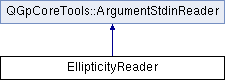
Public Member Functions | |
| EllipticityReader () | |
| bool | setOptions (int &argc, char **argv) |
Protected Member Functions | |
| virtual bool | parse (QTextStream &s) |
Brief description of class still missing.
Full description of class still missing
Description of constructor still missing
References QGpCoreTools::LogScale, and TRACE.
    : ArgumentStdinReader()
{
  TRACE;
  _nRayleigh=1;
  _samplingType=LogScale;
  _nSamples=100;
  _minRange=0.2;
  _maxRange=20.0;
  _outputCurves=true;
  _calculatePeaks=false;
  _signed=false;
  _oneMode=false;
}
| bool EllipticityReader::parse | ( | QTextStream & | s | ) | [protected, virtual] |
Implements QGpCoreTools::ArgumentStdinReader.
References QGpCoreWave::ModalStorage::abs(), QGpCoreWave::Dispersion::calculate(), QGpCoreWave::Seismic1DModel::fromStream(), QGpCoreWave::Seismic1DModel::layerCount(), QGpCoreWave::Ellipticity::peaks(), QGpCoreWave::Dispersion::setPrecision(), sOut(), QGpCoreWave::ModalStorage::toStream(), and TRACE.
{
  TRACE;
  QTextStream sOut(stdout);
  Seismic1DModel m;
  QString comments;
  if(!m.fromStream(s, &comments)) {
    return false;
  }
  if(m.layerCount()>0) {
    if(_nRayleigh>0) {
      Rayleigh rayleigh(&m);
      Dispersion dispersion (_nRayleigh, &_x);
      dispersion.setPrecision(1e-12); // Highest precision with double
      Ellipticity ell(_nRayleigh, &_x);
      // TODO: take errors into consideration
      dispersion.calculate(&rayleigh, &ell);
      QList<double> peaks[_nRayleigh];
      if(_calculatePeaks) {
        for(int im=0; im<_nRayleigh; im++) {
          peaks[im]=ell.peaks (im, dispersion, &rayleigh);
        }
      }
      if(!_signed) {
        ell.abs();
      }
      sOut << comments;
      if(_outputCurves) {
        sOut << QString("# %1 Rayleigh ellipticity mode(s)\n").arg(_nRayleigh);
        ell.toStream(sOut, _oneMode ? _nRayleigh-1 : -1);
      } else {
        for(int im=0; im < _nRayleigh; im++ ) {
          sOut << "# Mode " << im << "\n";
          for(int ip=0; ip < peaks[im].count(); ip++ ) {
            sOut << peaks[im][ip] << "\n";
          }
        }
      }
    }
  }
  return true;
}
| bool EllipticityReader::setOptions | ( | int & | argc, |
| char ** | argv | ||
| ) |
References QGpCoreTools::endl(), QGpCoreTools::Function, QGpCoreTools::InversedScale, QGpCoreTools::Curve< pointType >::line(), QGpCoreTools::LinearScale, QGpCoreTools::LogScale, QGpCoreTools::Curve< pointType >::resample(), QGpCoreTools::tr(), TRACE, QGpCoreTools::Curve< pointType >::xMultiply(), and QGpCoreTools::Curve< pointType >::xVector().
Referenced by main().
{
  TRACE;
  // Check arguments
  int i, j=1;
  for(i=1; i<argc; i++) {
    QByteArray arg=argv[i];
    if(arg[0]=='-') {
      if(arg=="-R") {
        CoreApplication::checkOptionArg(i, argc, argv);
        _nRayleigh=atoi(argv[i]);
      } else if (arg=="-one-mode") {
        _oneMode=true;
      } else if(arg=="-signed") {
        _signed=true;
      } else if(arg=="-s") {
        CoreApplication::checkOptionArg(i, argc, argv);
        if(strcmp(argv[i],"period")==0) {
          _samplingType=InversedScale;
        } else if(strcmp(argv[i],"frequency")==0) {
          _samplingType=LinearScale;
        } else {
          _samplingType=LogScale;
        }
      } else if(arg=="-min") {
        CoreApplication::checkOptionArg(i, argc, argv);
        _minRange=atof(argv[i]);
      } else if(arg=="-max") {
        CoreApplication::checkOptionArg(i, argc, argv);
        _maxRange=atof(argv[i]);
      } else if(arg=="-n") {
        CoreApplication::checkOptionArg(i, argc, argv);
        _nSamples=atoi(argv[i]);
        if(_nSamples<=0) {
          App::stream() << tr("gpell: negative or null number of samples (option -n)") << endl;
          return false;
        }
      } else if(arg=="-p") {
        _calculatePeaks=true;
        _outputCurves=false;
      } else if(arg=="-c") {
        _calculatePeaks=false;
        _outputCurves=true;
      } else if(arg=="-pc") {
        _calculatePeaks=true;
        _outputCurves=true;
      } else {
        App::stream() << tr("gpell: bad option %1, see -help").arg(argv[i]) << endl;
        return false;
      }
    } else {
      argv[j++]=argv[i];
    }
  }
  if(j < argc) {
    argv[j]=0;
    argc=j;
  }
  // Compute common sampling scale
  Curve<Point1D> c;
  c.line(_minRange, _maxRange);
  c.resample(_nSamples, _minRange, _maxRange, _samplingType | Function);
  c.xMultiply(2*M_PI); // convert to angular frequency
  _x=c.xVector();
  return true;
}


