

All Classes Namespaces Files Functions Variables Typedefs Enumerations Enumerator Properties Friends Defines

Brief description of class still missing. More...
#include <DaemonApplication.h>
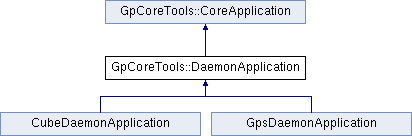
Public Member Functions | |
| const std::string & | basePath () const |
| virtual void | close () |
| DaemonApplication (int &argc, char **argv, ApplicationHelp *(*help)(), bool reportBugs=true) | |
| void | fork () |
| void | start () |
| ~DaemonApplication () | |
Protected Member Functions | |
| virtual void | installInterruptSignals () |
| virtual void | parentProcessWait () |
Static Protected Member Functions | |
| static void | childInterrupted (int signum) |
| static void | parentInterrupted (int signum) |
Brief description of class still missing.
Full description of class still missing
| GpCoreTools::DaemonApplication::DaemonApplication | ( | int & | argc, |
| char ** | argv, | ||
| ApplicationHelp *(*)() | help, | ||
| bool | reportBugs = true |
||
| ) |
Description of constructor still missing
References GpCoreTools::CoreApplication::checkOptionArg(), GpCoreTools::CoreApplication::exit(), and help().
    : CoreApplication(argc, argv, 0, reportBugs)
  {
    _doFork=true;
    _basePath="/var/log";

    // Check arguments
    int i, j=1;
    for(i=1; i<argc; i++) {
      const char * arg=argv[i];
      if(strcmp(arg, "-N")==0) {
        _doFork=false;
      } else if(strcmp(arg, "-b")==0) {
        checkOptionArg(i, argc, argv, true);
        _basePath=argv[i];
      } else if(strcmp(arg, "-l")==0) {
        checkOptionArg(i, argc, argv, true);
        _logFileName=argv[i];
      } else if(help && (strcmp(arg, "--help")==0 || strcmp(arg, "-help")==0 || strcmp(arg, "-h")==0)) {
        showHelp(i, argc, argv, help);
        ::exit(0);
      } else {
        argv[j++]=argv[i];
      }
    }
    if(j<argc) {
      argv[j]=0;
      argc=j;
    }

    if(_doFork) {
      checkPidFile();
    }
    checkBasePath();
    initLogFile();

    // Allocate it after initializing log
    _leds=new Leds;
  }
  {
    delete _leds;
  }
| const std::string& GpCoreTools::DaemonApplication::basePath | ( | ) | const [inline] |
Referenced by main().
{return _basePath;}
| void GpCoreTools::DaemonApplication::childInterrupted | ( | int | signum | ) | [static, protected] |
Reimplemented in GpsDaemonApplication, and CubeDaemonApplication.
References GpCoreTools::EventLoop::mainInstance(), GpCoreTools::EventLoop::terminate(), and GpCoreTools::Log::writeNoMutex().
Referenced by installInterruptSignals().
  {
    // Do not use TRACE here because it uses a mutex which can be locked while this function
    // is called inside a signal exception.
    Log::writeNoMutex(0, "received TERM or INTERRUPT signal\n");
    EventLoop::mainInstance()->terminate();
    // Returns to default handler in case the process did not stop properly
    signal(SIGTERM, SIG_DFL);
    signal(SIGINT, SIG_DFL);
  }
| void GpCoreTools::DaemonApplication::close | ( | ) | [virtual] |
Description of destructor still missing
Reimplemented from GpCoreTools::CoreApplication.
Reimplemented in GpsDaemonApplication, and CubeDaemonApplication.
References GpCoreTools::CoreApplication::applicationName(), and GpCoreTools::Log::write().
Referenced by main().
  {
    Log::write(0, "stop daemon with pid %i\n",getpid());
    remove(pidFile(applicationName()).data());
    CoreApplication::close();
  }
| void GpCoreTools::DaemonApplication::fork | ( | ) |
References GpCoreTools::CoreApplication::exit(), GpCoreTools::CoreApplication::initInternalDebugger(), parentInterrupted(), parentProcessWait(), and GpCoreTools::Log::write().
Referenced by main().
  {
    if(_doFork) {
      // Our process ID and Session ID
      pid_t pid, sid;
      pid=::fork();
      if(pid<0) { // Error, no child is created, -1 is returned to parent
        Log::write(0, "cannot fork off the parent process: %s\n", strerror(errno));
        exit(2);
      }
      // If we got a good PID, then we can exit the parent process.
      if(pid>0) {
        writePidFile(pid);
        // Eventually wait before exiting
        signal(SIGTERM, parentInterrupted);
        signal(SIGINT, parentInterrupted);
        parentProcessWait();
        ::exit(0); // Exits silently
      }
      // pid is null, hence we are in the child process
      // Change the file mode mask
      umask(0);
      // Create a new SID for the child process
      sid=setsid();
      if(sid < 0) {
        Log::write(0, "cannot create a new SID for the child process\n");
        exit(2);
      }
      initInternalDebugger();
    }
  }
| void GpCoreTools::DaemonApplication::installInterruptSignals | ( | ) | [protected, virtual] |
Reimplemented in GpsDaemonApplication, and CubeDaemonApplication.
References childInterrupted().
Referenced by start().
  {
    signal(SIGTERM, childInterrupted);
    signal(SIGINT, childInterrupted);
  }
| void GpCoreTools::DaemonApplication::parentInterrupted | ( | int | signum | ) | [static, protected] |
References GpCoreTools::CoreApplication::applicationName(), GpCoreTools::CoreApplication::exit(), and GpCoreTools::CoreApplication::instance().
Referenced by fork().
  {
    // Kill child process
    std::string pf=pidFile(CoreApplication::instance()->applicationName());
    FILE * fpid=fopen(pf.data(), "rt");
    if(fpid) {
      pid_t pid;
      if(fscanf(fpid, "%u\n", &pid)==1) {
        kill(pid, SIGINT);
      }
      fclose(fpid);
    }
    // Nicer output of runscript if parent process is printing messages
    printf("\n");
    exit(2);
  }
| virtual void GpCoreTools::DaemonApplication::parentProcessWait | ( | ) | [inline, protected, virtual] |
References installInterruptSignals(), and GpCoreTools::Log::write().
Referenced by main().
  {
    installInterruptSignals();

    Log::write(0, "start new daemon with pid %i\n",getpid());
  }

