

All Classes Namespaces Files Functions Variables Typedefs Enumerations Enumerator Properties Friends Defines

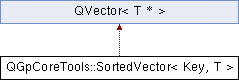
A vector of sorted elements. More...
#include <SortedVector.h>
Public Member Functions | |
| void | append (T *o) |
| T * | at (int index) const |
| void | clear () |
| bool | contains (const Key &k) const |
| int | count () const |
| int | indexOf (const Key &k) const |
| void | insert (T *o) |
| bool | isEmpty () const |
| void | remove (int index) |
| void | reserve (int n) |
| void | sort () |
| SortedVector () | |
| const QVector< T * > & | vector () const |
A vector of sorted elements.
Provides fast lookup (equivalent to QMap) on vector based storage. Probably less memory consumption than a QMap but slower insertions.
| QGpCoreTools::SortedVector< Key, T >::SortedVector | ( | ) | [inline] |
{_n2=1;}
| void QGpCoreTools::SortedVector< Key, T >::append | ( | T * | o | ) | [inline] |
Adds object o to the end of the vector. The vector is not automatically sorted and search functions cannot be used before a proper initialization of all object keys and a call to sort(). This function may be of interest if keys are not available at the time of insertion.
{QVector<T *>::append(o);}
| T* QGpCoreTools::SortedVector< Key, T >::at | ( | int | index | ) | const [inline] |
| void QGpCoreTools::SortedVector< Key, T >::clear | ( | ) |
Reimplemented in GeopsyCore::MetaDataMap.
{
  QVector<T *>::clear();
}
| bool QGpCoreTools::SortedVector< Key, T >::contains | ( | const Key & | k | ) | const [inline] |
{return indexOf(k)>-1;}
| int QGpCoreTools::SortedVector< Key, T >::count | ( | ) | const [inline] |
Reimplemented in GeopsyCore::MetaDataMap.
Referenced by GeopsyCore::SharedMetaData::add().
{return QVector<T *>::count();}
| int QGpCoreTools::SortedVector< Key, T >::indexOf | ( | const Key & | k | ) | const |
Returns the index of o or -1 if o does not exist
{
  if(count()<12) { /* For few elements, faster to check systematically
                      n integer comparisons
                      n increments
                      n object comparisons
                   */
    for(int i=count()-1; i>=0; i--) {
      if(k==at(i)->key()) return i;
    }
    return -1;
  } else {        /*
                    4+2*l object comparisons
                    2*l   integer comparisons
                    3*l   increments (including bit shifts)
                    With l=ceil(log2(n)), e.g. n=12, l=4: 12 oc  8 ic  12 i
                                                  7, l=3: 10 oc  6 ic   9 i
                                                 20, l=5: 14 oc 10 ic  15 i
                                                100, l=7: 16 oc 14 ic  21 i
                  */
    if(k<at(0)->key()) return -1;
    if(k==at(0)->key()) return 0;
    int lasti=count()-1;
    if(k>at(lasti)->key()) return -1;
    int i=_n2;
    int step2=_n2 >> 1;
    while(step2>0) {
      if(i>lasti) {
        i-=step2;
      } else {
        const Key& ki=at(i)->key();
        if(k<ki) {
          i-=step2;
        } else if(k>ki) {
          i+=step2;
        } else {
          return i;
        }
      }
      step2=step2 >> 1;
    }
    if(k==at(i)->key()) {
      return i;
    } else {
      return -1;
    }
  }
}
| void QGpCoreTools::SortedVector< Key, T >::insert | ( | T * | o | ) |
{
  int i=indexAfter(o->key());
  QVector<T *>::insert(i, o);
  while(_n2<count()) _n2=_n2 << 1;
}
| bool QGpCoreTools::SortedVector< Key, T >::isEmpty | ( | ) | const [inline] |
{return QVector<T *>::isEmpty();}
| void QGpCoreTools::SortedVector< Key, T >::remove | ( | int | index | ) |
Reimplemented in GeopsyCore::MetaDataMap.
{
  QVector<T *>::remove(index);
  int n2=_n2 >> 1;
  if(n2>0 && n2>=count()) {
    _n2=n2;
  }
}
| void QGpCoreTools::SortedVector< Key, T >::reserve | ( | int | n | ) | [inline] |
Reimplemented in GeopsyCore::MetaDataMap.
{QVector<T *>::reserve(n);}
| void QGpCoreTools::SortedVector< Key, T >::sort | ( | ) | [inline] |
Sort the obects. This function is required only when object are added using append(). On the contrary, insert() keeps the vector properly sorted.
{qSort(QVector<T *>::begin(), QVector<T *>::end(), lessThan);}
| const QVector<T *>& QGpCoreTools::SortedVector< Key, T >::vector | ( | ) | const [inline] |
Reimplemented in GeopsyCore::MetaDataMap.
{return *this;}

